
Japanese Traditional Medicine and Its Connection with Traditional Chinese Medicine
Japanese traditional medicine has its roots in Traditional Chinese Medicine (TCM), from which it inherited fundamental theoretical principles, diagnostic models, and therapeutic practices. Introduced to Japan between the 5th and 6th centuries through cultural and religious exchanges, Chinese medical knowledge was gradually absorbed and adapted to the Japanese cultural and social context.
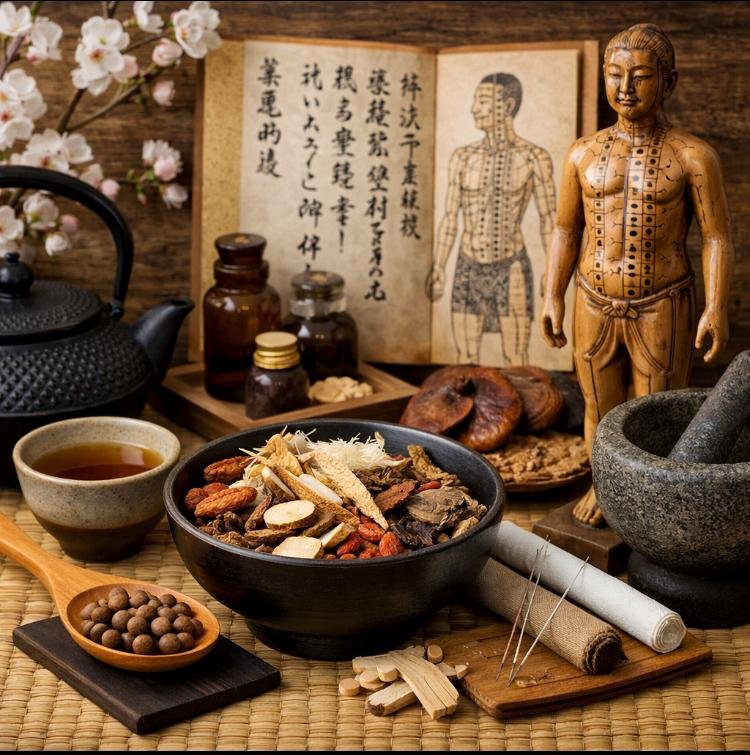
Over time, this process of adaptation led to the development of an autonomous medical system known as Kampō. While Kampō preserves core concepts of Traditional Chinese Medicine—such as Qi, the balance of Yin and Yang, and the theory of the Five Phases—it is distinguished by a more pragmatic and clinically oriented approach. Japanese traditional medicine places strong emphasis on direct observation of the patient and on the evaluation of tangible, observable symptoms rather than on complex theoretical constructs.
Herbal medicine represents a key point of continuity between the two traditions. However, whereas Traditional Chinese Medicine has evolved into a wide range of schools and formulations, Japanese Kampō medicine has followed a more selective and standardized path, focusing on reproducibility, safety, and clinical effectiveness.
Significant differences are also evident in diagnostic methods. Japanese traditional medicine tends to simplify classical Chinese diagnostic techniques, concentrating on essential parameters such as abdominal diagnosis, constitutional assessment, and functional responses of the body. This pragmatic orientation has facilitated the integration of Kampō into Japan’s modern healthcare system, where it continues to be used alongside conventional Western medicine.
In conclusion, Japanese traditional medicine offers a compelling example of how ancient medical knowledge can be transmitted, refined, and transformed across cultures. While maintaining a deep and enduring connection with Traditional Chinese Medicine, it has developed a distinct identity characterized by simplicity, clinical practicality, and therapeutic efficiency.
_ Jade Springstone