
Discoveries on the Giza Plateau raise urgent uestions about the History of Pyramids before and after the Flood
Giza Pyramids: Are They Just the Tip of the Iceberg of Pre-Flood Egyptian Civilization?

⊚ Cairo – Amr AbduLRahman – Exclusive To (AISC News)
.
A question recently arose in my mind, perhaps awaiting an answer from independent international experts engaged in the project of reconstructing the true history of Egypt through the eyes and hands of the Egyptians themselves, and not through the narratives of colonial scholars who continue to spread falsehoods such as that the pyramids were tombs, that the ancient Egyptians worshiped idols and multiple deities such as Ptah, Horus, and Hermes, and that they were pharaohs, etc.:
The hypothetical question is this: I read somewhere that the Great Flood destroyed the architectural system of the pyramids, rendering them unusable. Is this true?
Before answering:
Remember that Egyptian civilization began long before the Flood (12,000 years ago). Civilizations then spread throughout the world again after the Flood, in the era erroneously called the Neolithic!
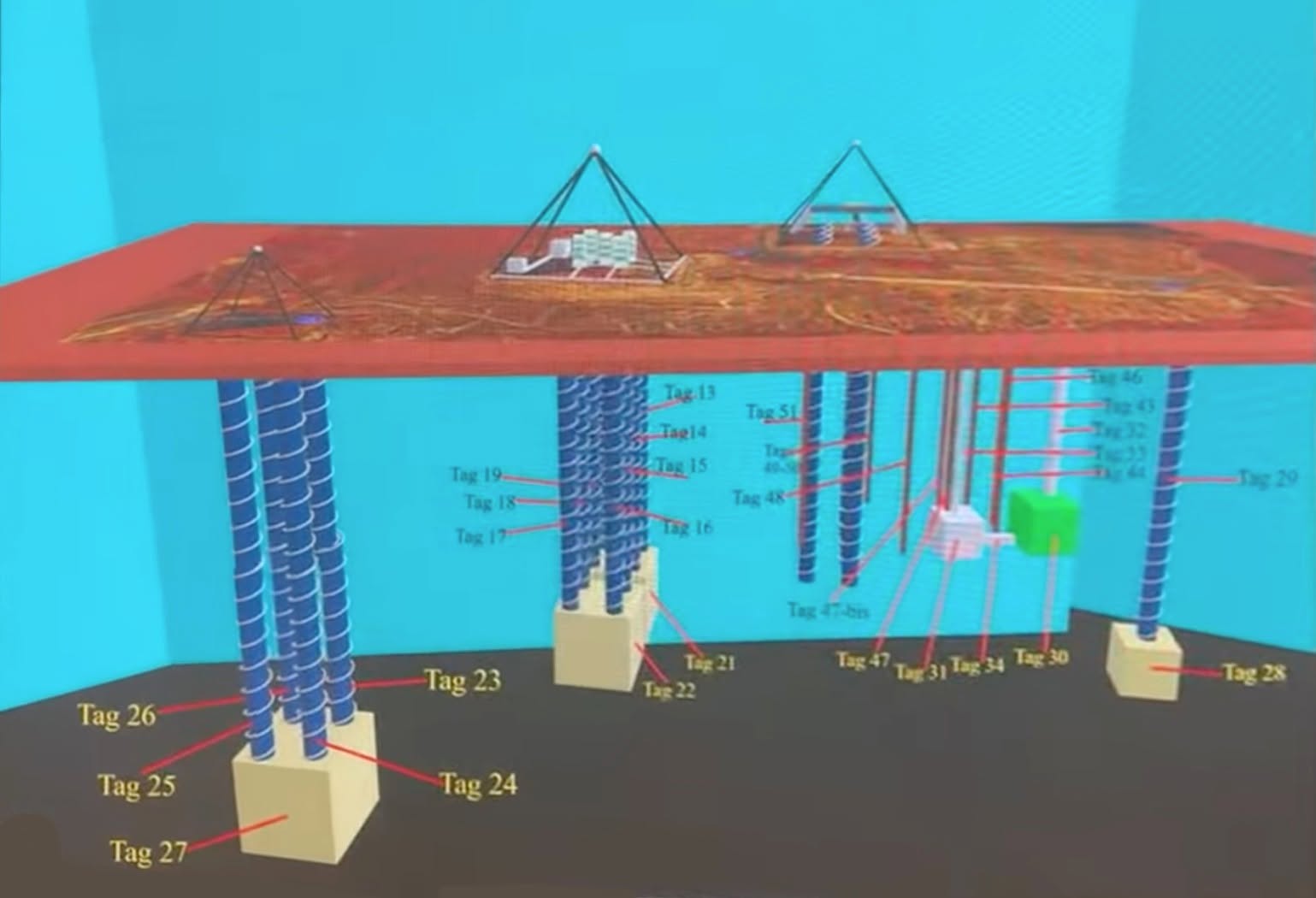
The second question concerns some extraordinary discoveries made by independent international researchers on the Giza plateau, using non-fossil techniques. These discoveries have demonstrated the existence of enormous chambers and structures beneath the plateau.
Among these are the discoveries of researcher Armando May and his colleagues Corrado Malanga and Filippo Biondi, who identified gigantic spiral structures, columns, and cubic chambers thousands of meters deep beneath the Pyramid of Khafre and other pyramids, using advanced satellite-based Synthetic Aperture Radar (SAR) technology.
.
These legendary halls may contain priceless texts capable of rewriting the history of ancient Egypt.
Doesn’t this mean that these structures were at ground level before the Flood?
But were they destroyed after the Flood, first submerged by salt water for long periods?
And that the Earth then entered a period of humid climate for about 3,000 years before the onset of global aridity?
This event led to what is known in geology and climatology as the 4.2-thousand-year event,
which refers to one of the most severe periods of climatic aridity, desertification, and sand advance that the Earth has ever experienced in the late Holocene, around 2200 BC.
This event lasted for several centuries and led to radical climate changes in many regions of the world, causing the collapse of important ancient civilizations.
The result for the Giza plateau: the pyramids and the Sphinx remained buried under the sand until today, at a depth of about 648 meters below the Earth’s surface?
.
This is the depth at which these colossal structures were discovered, which may have been part of the great pre-Flood Egyptian civilization, of which the current pyramids, the Sphinx, and the great temples were only a fraction; or perhaps just the tip of the iceberg of the true Egyptian civilization, buried under the sand for five thousand years?
It is worth emphasizing what the editor highlights in his book *The Sphinx: Keeper of the Unknown Secret*: the beginning of the new era of Egyptian civilization after the Flood saw the rise of royal dynasties, whose primary task was always to remove sand from the pyramids and the Sphinx, to maintain them, and to restore their exterior facades, damaged by the Flood and the subsequent inundation of salt water and then sand.
This is revealed by the Sphinx stele carved between the arms of the great statue, with an inscription from King Thutmose IV, documenting the removal of sand from the statue…
.
.
.


⊚ Author of the article:
.
◙ Executive Director of the International Center for Pyramid Sciences and Science Ethics (Shams El-Nil) – ([I.C.P.S.E.S]).
.
◙ Executive Director of the international news agency “Media Without Borders” [AISC NEWS].
.
◙ Author of The Book: Sphinx: Guardian of the Enigmatic Secret.