

The Khafre project gains new positive dimensions with the praise of Dr. Wassim El-Sisi and the efforts of archaeologist Armando May & Partners…
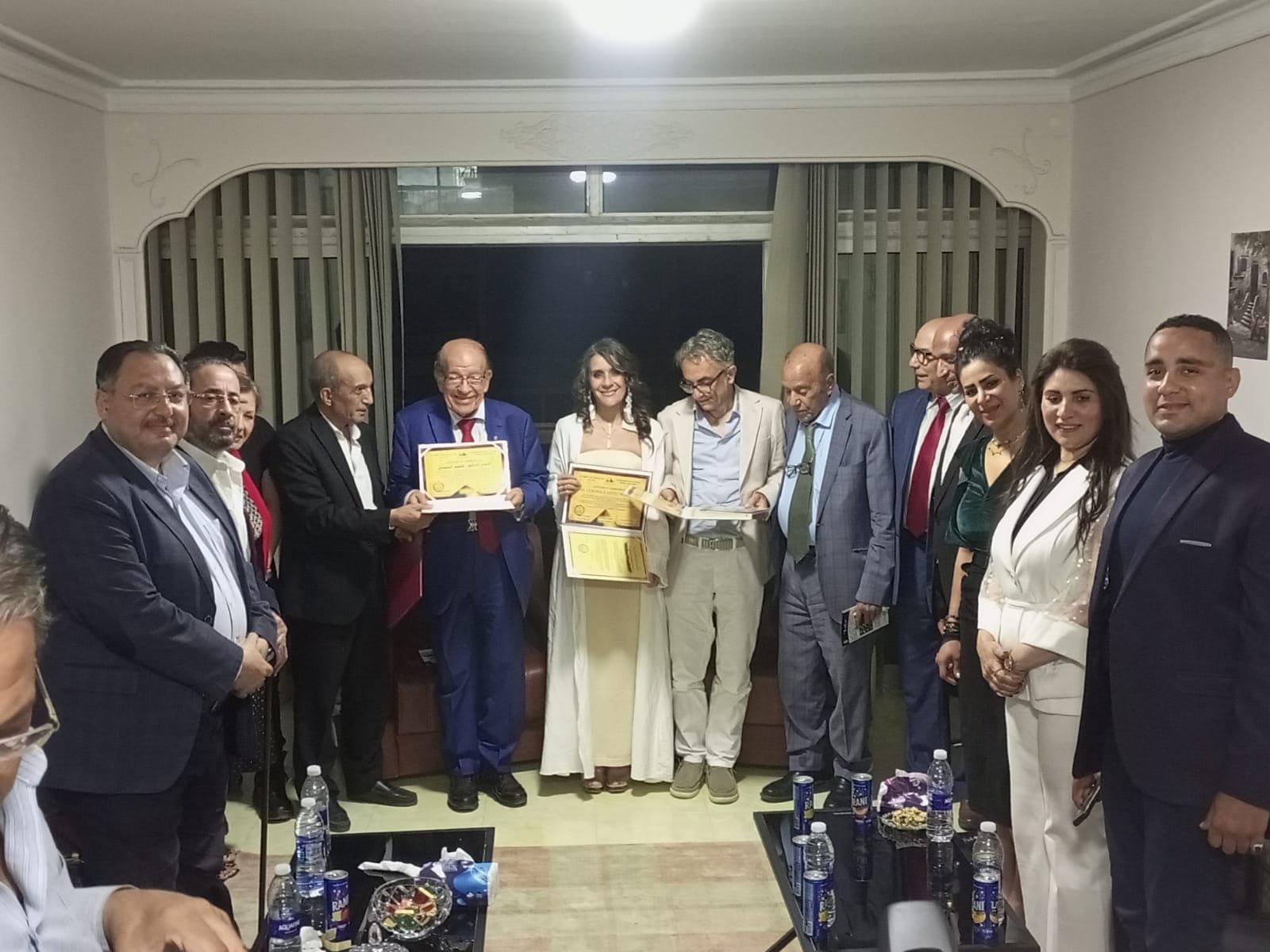
◙ Positive feedback on the honoring of archaeological researchers Dr. Wassim El-Sisi, Armando May and his wife, Christopher Dunne and Robert Bauval by the [International Center for Pyramid Sciences and Ethics of Science]...

Cairo – Amr AbduLRahman – Exclusive to [AISC News]
In a recent article, Dr. Waseem El-Sisi expressed his optimism regarding the recent intensive archaeological efforts to rewrite the true history of Egypt and explore the secrets of its technological civilization, especially in light of the archaeological research conducted in the Giza Plateau region within the framework of the Khafre Pyramid Project, an exploratory study led by the Italian explorer Armando May in collaboration with the space engineer Filippo Biondi and the scientist Corrado Malanga, using advanced radar techniques to detect what lies beneath the Giza Plateau.
Dr. Waseem El-Sisi also expressed his delight at the historical, research, and technological collaboration with the International Center for Pyramid Sciences and the Ethics of Science, and its president and founder, Dr. Ahmed Nassar, who had previously invited him to attend a ceremony honoring and presenting certificates of appreciation to the following individuals:
⊚ Dr. Waseem El-Sisi, author of pioneering and revolutionary historical research in Egyptology.
⊚ Dr. Armando Mei and his wife, the archaeologist Veronica Antelli Melantoni.
This was especially significant following Armando’s announcement of the establishment of the Egyptian Heritage Research Foundation.
He is also the author of the following books:
- The Gate of Amenti
- The Key to Time
- The Secret of Pyramid Number 137
- 36,400 Years: The History of the Pyramids
.
⊚ American archaeologist Christopher Dunn, author of the important books:
- Lost Technology in Ancient Egypt
- The Giza Power Plant
- Giza: The Tesla Connection
⊚ Belgian archaeologist Robert Bauval, author of the book and theory “The Orion Mystery,” which was a key element of the Grand Egyptian Museum’s opening ceremony.
It is worth noting that the archaeological team working in the Giza Plateau area consists of:
- Dr. Armando May (Head).
- Scientist Filippo Biondi, patent holder of the Synthetic Aperture Radar (SAR) – capable of detecting the subsurface to a depth of 3,000 meters.
- Scientist Corrado Malanga.
Dr. Waseem pointed out that the team succeeded in achieving remarkable results using non-invasive archaeological techniques, specifically geophysical surveying, without excavation or damage to the antiquities.
The discovery of colossal structures—pillars encased in spiral wires—beneath the Pyramid of Khafre, at a depth of 643 meters, was presented at several international conferences, including those in Chicago, Italy (March 16, 2025), and Sweden (May 2026).
The archaeological team also conducted further research, which proved that the pyramids were not built during the Fourth Dynasty, but rather underwent periodic maintenance of their outer casings during the reign of King Khufu. This conclusion was reached through a careful reading of the Wadi al-Jarf papyri, discovered in 2013.
In these papyri, we read that the Egyptian engineer in charge, [Merer]—the foreman—records the transport of limestone blocks from the Suez quarries via the ancient branch of the Nile leading to the Giza Plateau, the site of the “Khufu Horizon” project.
The evidence is that these stones were limestone, the same type used for the outer casing of the pyramids, and not granite, the rock from which the pyramids were built.
According to the research findings, catastrophic errors were made by those who explored the area in antiquity, such as the British Colonel Howard Vyse in 1837. He discovered inscriptions in red ink inside the relief chambers, written by construction workers, containing the names of the work crews and the name of King Khufu within a royal cartouche.
Vyse had taken these translations from the archaeologist John Wilkinson. Wilkinson later discovered his errors and corrected them, but it was too late. The incorrect translations published by Vyse had already become the officially recognized and accepted version, even to this day!
.
These were the only inscriptions throughout the entire pyramid, and they were grammatically incorrect. When shown to the archaeologist James Henry Breasted, president of the University of Chicago and author of *The Dawn of Conscience*, he said: “This writing does not conform to the hieroglyphs of the Fourth Dynasty, but rather to a more recent hieroglyphic script, meaning it was added after the end of the Old Kingdom.”
.
Dr. Armando May condemned the actions of British Colonel Weiss, who dynamite-blasted the pyramid walls under the pretext of exploring its interior!
.
Dr. Armando emphasized that paragraph 305 of the Pyramid Texts states:
“After death, the soul goes to heaven, while the body goes to earth.”
Therefore, it is incorrect to call it the burial chamber of King Khufu, as the classical archaeological school claims globally, because the chamber is located at a height of 43 meters.
This contradicts the idea of burying the body underground. If we accept that Khufu’s burial chamber was at this height, then he must have been a heretic or a blasphemer—even more heretical than Akhenaten.
.
.
.
◙ Editor’s Note:
It is worth noting that the ancient Egyptians buried their dead according to their monotheistic beliefs, underground, without any tombs, domes, or burial mounds (like the kurgans) famous among the Hyksos and Indo-European kingdoms.








![[Egyptian writer | Amr Abdel Rahman]](https://en.aiscnews.it/wp-content/uploads/2026/07/AMR-AMRE-NEW-TV-390x220.jpg)