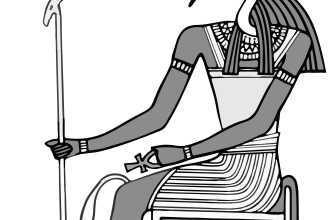

What Lies beneath Giza Plateau , and The Truth about [Thoth] – [THUT]…
⊚ቶ ⊚Commentary by " The Misrian Writer ": Amr AbdulRahman on the discoveries of the world-Renowned Italian Archaeologist : Armando May, and his World-class Archaeological Team.


.
⊚ At First: A special dedication to the renowned Italian archaeologist, Armando May, and his team, in recognition of their distinguished studies and significant discoveries at the Saqqara Plateau (Giza), most notably the existence of a city with structures and columns beneath the plateau’s surface.
.
.. It is a commendable scientific courage, for his outstanding contribution to rewriting the history of ancient Egyptian civilization, going beyond the classical narrative, towards a more truthful reading of an important part of human heritage in a comprehensive manner, restoring the higher values of Egyptian civilization and enabling it to lead the general consciousness of humanity and freeing the sciences of the pyramids from political agendas, which is a dream that has haunted the world’s scholars of history.
.
┗─┅─═ঊ⊚ঊ═─┅─┛
.
███ INTRODUCTION…
.
█ In the beginning was the first human being [Atum | “Adam” – peace be upon him].
.
█ Then [Osiris | “Idris”] – the first of the prophets – peace be upon them, to realign the faith on the compass of monotheism.
.
█ He was the first to teach the Egyptians the foundations of civilization in its broadest universal sense, beginning with their pioneering alphabet; [the sacred inscription | hieroglyphics] – the basis of all human alphabets.
.
█ And the first to establish for them temples of knowledge and faith.
.
█ For example;
.
◙ 1_ The Temple of On in the first capital of Egypt; [Memphis];
.
◙ 2_ The Temple of Ipet-Sut – known in Arabic as Karnak – in the city of Thebes – the city of the royal scepter; [Waset] in hieroglyphs.
.
█ He also erected the pillars of monotheism/obelisks – the [Tekhnu] – topped by the pyramidal peaks of the [Benben] – an architectural stone expression of the [primordial hill] that emerged from the water and upon which life first appeared on Earth, by the power of the creator god [Ptah].
.
█ As for the Giza Plateau and Saqqara (or Sukkar), the central base of the global pyramid network and the pinnacle of Egyptian civilization, they served as the primary source for disseminating cosmic energy throughout the Earth. This was achieved through technology that maintained the Earth’s crustal balance, mitigating the effects of earthquakes by absorbing seismic impulses from the Earth’s interior should their intensity increase.
.
█ The pyramids also act as a condenser, capturing, condensing, and amplifying the Earth’s resonances—currently known as Schumann resonances—to generate a flow of electromagnetic energy for a wide range of applications in industry, energy, and other sectors.
.
█ The pyramids’ Egyptian name is [Pyramid], which the Greeks, as was their custom with names, pronounced by adding an ‘s’, becoming Pyramids. From there, it passed into other Indo-European languages, such as Latin and English, etc.
.
█ As for the early kings of Egypt, they laid the foundations of good governance based on the triad of knowledge, faith, and just power—necessary to secure the internal front, the strategic borders of the state, and its national security borders extending to the Euphrates in the east, the sources of the Nile in the heart of Africa in the south, and reaching Anatolia and the borders of the Caucasus (the original homeland of the nomadic Hyksos tribes) in the north.
.
█ Egyption Sovereignty was imposed over the Aegean islands, and the title “Lord of the Aegean Islands” remained with the kings of Egypt since the reign of King Narmer, as recorded on the Stele of Loyalty issued by Ahmose I to commemorate the heroism of his mother, Ahhotep, the mother of the heroes who expelled the Hyksos. This title remained in use until ancient Egypt lost it during the reign of Akhenaten.
.
█ Therefore, the history of Egyptian civilization must be re-examined linguistically, historically, geographically, and technologically.
.
█ In response to the false accusations leveled against us, we declare that our kings were not “cursed pharaohs.”
.
█ Nor were our ancestors—in most of their eras—worshippers of gods like “Atum,” “Thoth,” and “Horus,” etc. These are merely names given by scholars of ancient and modern colonialism.
.
█ They are simply [Neter]—that is, names and attributes of the One and Only God.
.
█ And our colossal pyramids were not tombs.
.
█ The double statue [Roti] – named [Hor-am-Akhet], meaning: the supreme god, [Horus] – dweller of the celestial horizon [Hema-Akhet]; known in Arabic as the Sphinx; is not an idol but an architectural embodiment, crafted from the stones of eternity, of [the Mother of the World], welcoming the sunrise and sunset of the god.
.
█ All of these are achievements and miracles of our great ancestors, their documented civilizational imprint – a permanent mark – on every one of its millions of artifacts, bearing the name: [The Character of Egypt].
.
█ Thus, we reclaim the [intellectual property rights] of the Egyptian civilization, not a civilization built by invaders of outer space, as some claim, unable to comprehend the reality of the Egyptians’ construction of this sophisticated civilization!
.
█ On this basis, ancient Egyptian technology can be reactivated to be the key to true humanity and to restore the values of the [safe city] within the unprecedented development projects for which The International Center for Pyramid Sciences and Ethics of Science [I.C.P.S.E.S] bears responsibility, In collaboration with our partners, including:
[Egyption Heritage Research Foundation].
.
┗─┅─═ঊ⊚ঊ═─┅─┛
.
███ Returning to Geohistorical Roots
.
█ The truth is that the current Earth’s surface in Egypt and the entire world was formed in its desert appearance following the Flood – approximately 12,000 years ago – and then the onset of a climate shift and a global drought during what is known as the 4.2-kiloyear event, 8,200 years ago.
.
█This coincided with the end of the Pleistocene epoch, which began 12,000 years ago and ended with the end of the last Ice Age (Younger Dryas) and the retreat of glaciers, thus marking the beginning of the Holocene epoch, coinciding with the beginning of the Neolithic period.
.
█ The green lands of Egypt, Africa, and Asia were transformed into layers of sand and desert, and the civilizations of many peoples that flourished along the great rivers of ancient Egypt, ancient India (the Milwaukee), and ancient China (the Huashan) collapsed.
.
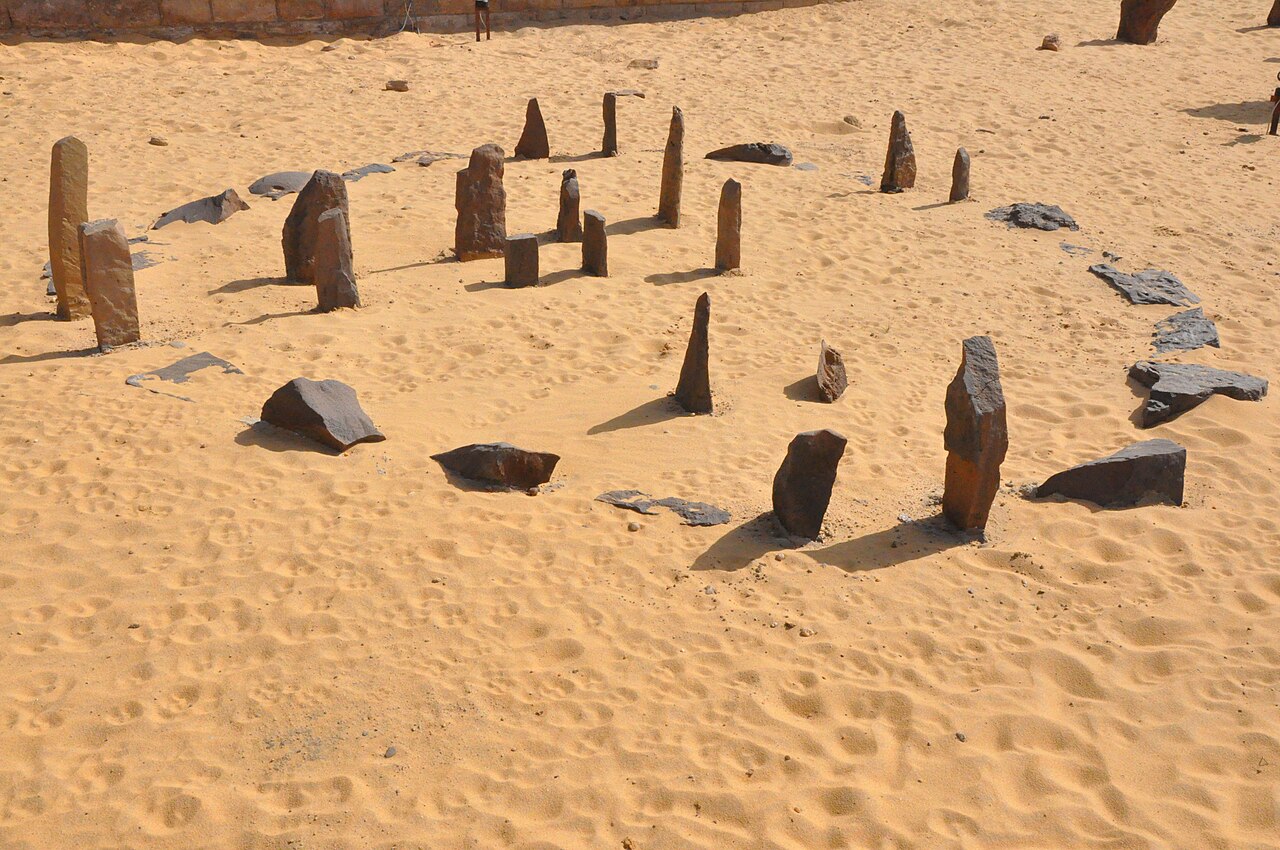
█ Similarly, in Europe, remains such as the colossal stone circles of Stonehenge, similar to those found in southern Egypt, such as those at Napata and Playa.


.
███ The emergence of the Eurasian Hyksos
.
█ This also led to the great waves of migrations undertaken by nomadic Eurasian tribes, such as the Yamnaya culture, which emerged in the Eurasian steppes (present-day Russia and Ukraine) during the late Chalcolithic and early Bronze Ages (c. 3300–2600 BCE), with a patrilineal lineage [R1].

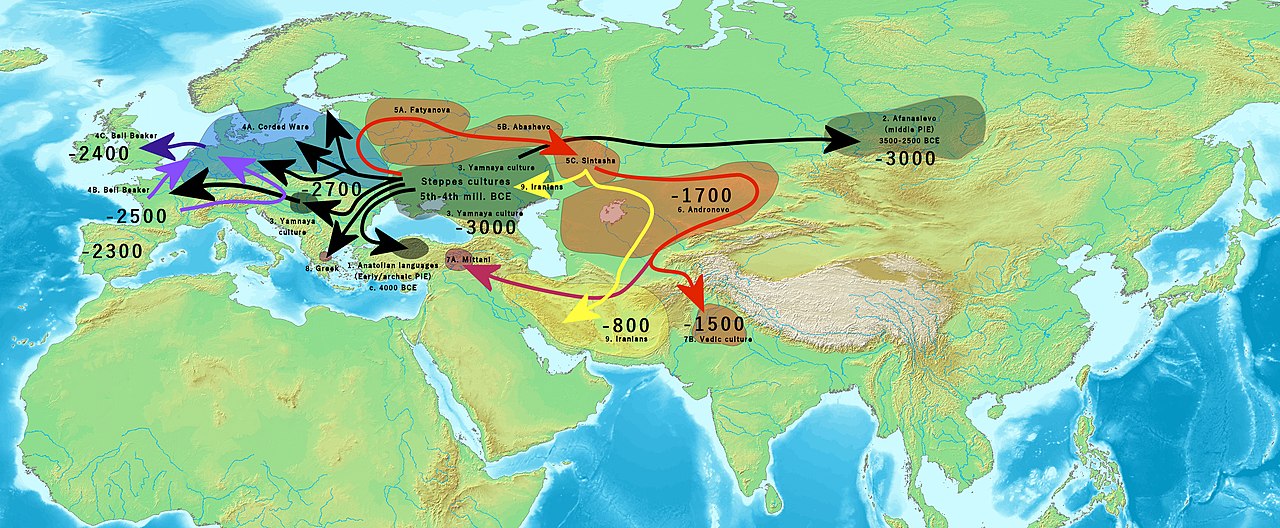
█ These nomadic tribes temporarily settled in the Eurasian steppes between the Caspian and Black Seas, around the Oxus River. From there, their migrations spread across the globe, fleeing the aridity of their pastures. They were the first to domesticate horses, transforming them into chariots (Mariots) and establishing cavalry (Mariannu). This was the secret to an unconventional military force used by the nomadic Bedouin who founded the Hyksos kingdoms.
.
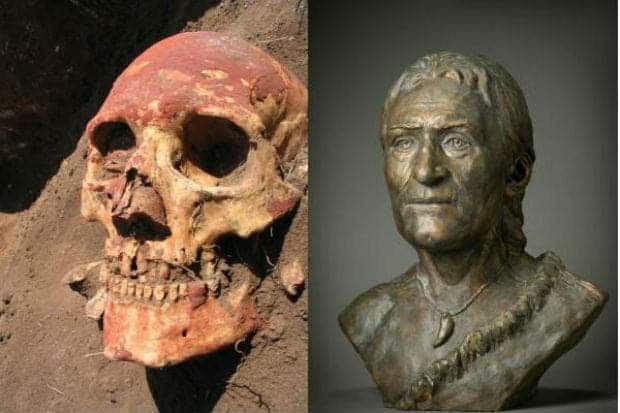
The Kernosivsky idol (Yamnaya)


.
███ Civilizational Collapse and Rise
.
█ Despite the harsh climate and periods of weakness that Egypt and other regions experienced, the kings of Egypt restored its strength by reunifying the country through a unified religious doctrine—as found inscribed on the monuments of King (Narmer), whose title was “Menes”, meaning “the founder,” in hieroglyphs.
.
█ With the beginning of the [dynastic era], the kings took great care to preserve what they had inherited from their ancestors: the sciences, pyramids, and the Sphinx, most of which were buried under the sand.
.
█ There is much evidence, including that King Thutmose IV removed the sand from the Sphinx and claimed to have done so after a spiritual dream, in exchange for a divine promise to rule Egypt! This is a famous lie that he used to seize power.
.
█ However, it proves the fact that most of the relics of pre-flood Egyptian civilization have been buried under the sand since the period of global drought 8200 years ago.
.
█ Therefore, there is an entire life buried beneath the surface of the earth.
.
█ Another fact established by the archaeologist the archaeologist Dr. Reda Abdel-Halim is that the statue of Horus-Akhet (the Sphinx in Arabic) has a twin opposite it in its location on the plateau.
.
█ The statue originally resembled the body and head of Mehit (the lioness) before the head was destroyed and the statue damaged during the Flood, which submerged the entire plateau with saltwater for extended periods, leaving its mark on the statue’s base and the pyramids.
.
█ The head was then reconstructed and the body restored during the Fourth Dynasty, but in the form of the head of King Khafre – approximately 5,000 years ago.
.
███ Egypt is not Pharaonic
.
█ Also, one of the most important pillars of the task of rewriting Egyptian history is proving that its kings were not “Pharaohs”.
.
“ █Pharaoh” was the name of the king preceding the last king, “Khamudi,” among the Hyksos kings who occupied the Nile Delta for approximately 200 years. Their culture was neither Egyptian nor Arab, but rather Eurasian Indo-European, originating in the land of Turan between the Caspian and Black Seas and around the Oxus River (OXUS) – from which the name [HqA(w)-xAswt] in hieroglyphs is derived – according to Manetho’s Egyptian history;
.
█ In Greek, it was pronounced: Hyksos.
.
█ The word (Hyksos ὑκσώς) is a loanword in ancient Greek, as it is derived from Egyptian hieroglyphs.
.
█ It is pronounced with a pause and a measured final accent on the omega, meaning it does not adhere to the rules of ancient Greek pronunciation. It is one of the rare words in which the letter κ (kappa) is followed by the letter σ (sigma) instead of the more common use of the letter xi (si.(
.
█ The conquerors followed religious rituals foreign to the Egyptians but found in Eurasia, such as the burial of the dead and horses in domed burial mounds (kurgan), as discovered in their capital, Auris. These rituals originated in Eurasia (Central Asia and Central Europe) and spread between Asia and Europe.
.
███ Hermes and Asclepius are Greek gods foreign to Egypt.


█ On the other hand, in the context of correcting history, the sciences, culture, and civilization of ancient Egypt have no connection to figures like Hermes or Asclepius.
.
█ Nor is there any connection between Hermes and the Prophet Idris, who lived before the Prophet Noah and the Flood.
.
█In fact, the falsification of Egyptian history did not begin with the French and British occupation;
.
█ but rather with the Greek occupation of Egypt. The aim was to normalize the symbols of Egyptian and Greek culture so that Egyptians would accept the occupation amicably and not resist it.


███ Hermeticism is an Indo-European culture.
.
█ The truth is that (Hermes Ἑρμῆς) is an ancient god whose worship began in the land of Turan, then he was worshipped by the Persians, then the Greeks and the Romans, and thus he became one of the Indo-European gods.
.
███ In Greco-Indo-European culture, Hermes is the son of the god Zeus and the divine nymph Māyā.
.
█ Hermes is the father of the god Pan. He is half-human and half-goat (legs and hooves), and he has horns symbolizing the connection between earth and sky.
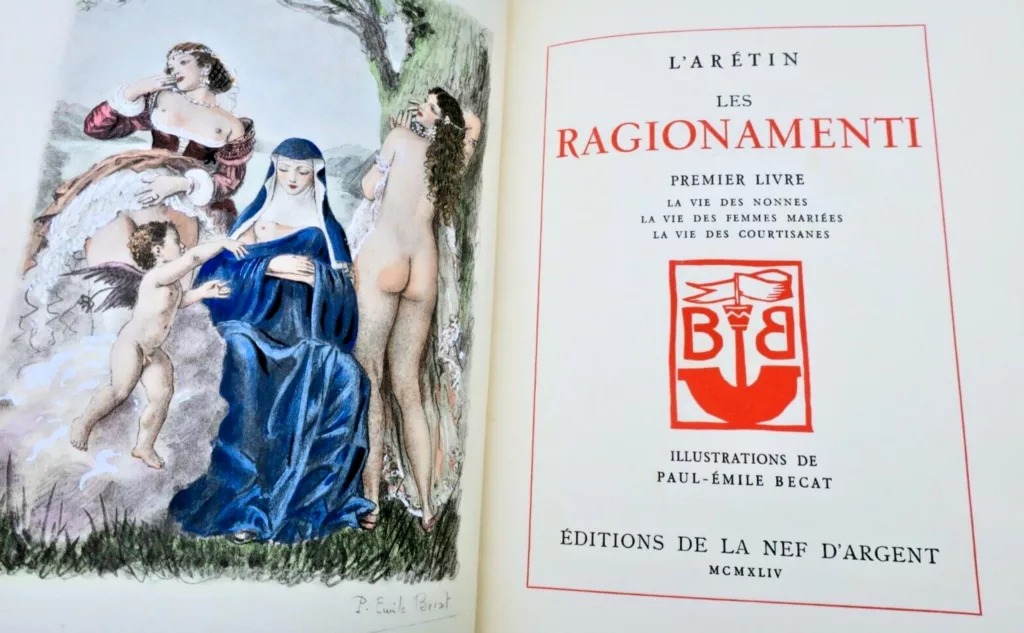
█ He was later associated with the goddess Baphomet, one of the incarnations of Lucifer, depicted as a sabbatic goat, a symbol of the “Balance” between opposites (male/female, human/animal, light/darkness).
.
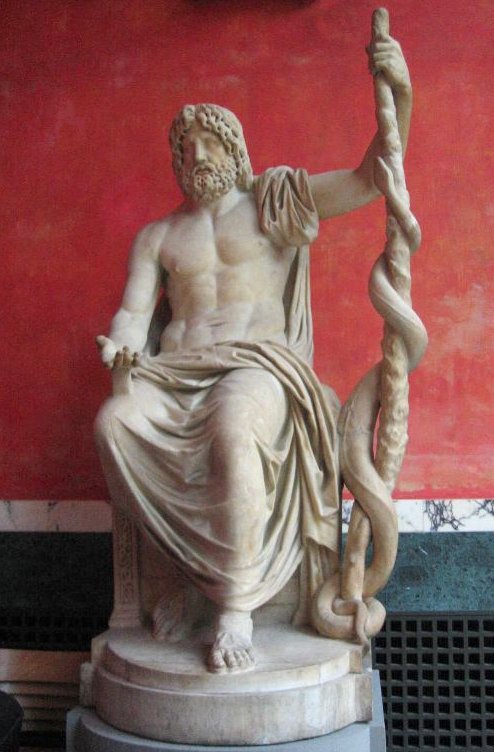
█ He is symbolized by a mace (kadousios), a rod with two snakes coiled around it—a symbol with sexual connotations!
.
█ It is known that Hermes’ scepter, in another of his incarnations, is positioned at the hip of the idol Baphomet, one of the incarnations of Lucifer (the Devil).

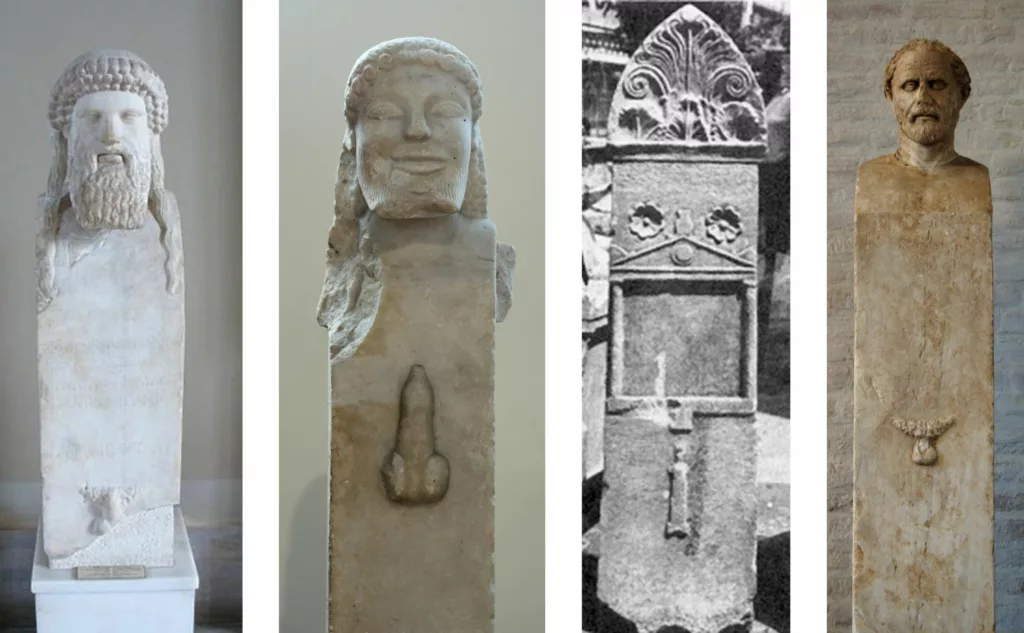
█ In ancient Greek religion, Hermes was closely associated with the phallus as a symbol of fertility, boundaries, and good fortune. It was depicted as a column surmounted by a bust of Hermes with an erect phallus at waist level. This was believed to enhance the fertility of the family and ensure the masculine potency of the head of the household.
.
█ The phallus had its own Greek deity: Priapus, who was attributed to Hermes – or to Dionysus through his wife, the goddess Aphrodite.
.
█ Hermes was also associated with other figures with masculine connotations, such as his son, the god Pan – the god of nomadic tribes – who was depicted with an enormous phallus!
.
█ It is associated with the Hermetic culture, where the Greeks in Athens erected the Pillars of Hermes, with their distinctive rods, to mark roads and intersections and protect public spaces, as Hermes was the god of travelers and fertility.
.
█ It was a powerful presence in ancient Greece as a sacred symbol, appearing in everything from votive architecture to jewelry, fountains, and murals in merchants’ palaces.
.
█ Even children were not spared this symbol; they were given amulets adorned with winged genitalia, called “fascinum,” to protect them from the evil eye.
.
█ It was also displayed on the front of victorious chariots…
.
█ In short, it is the origin of car emblems!
.
█ From this cultural hybrid imposed by the Greeks emerged the figure of (Hermes Trismegistus Ἑρμῆς ὁ Τρισμέγιστος) – through the unfair normalization between the Greek god Hermes and what is called: the Egyptian god [Thoth!].
.
█ Thoth – or “THUT” is Not a god – rather a descriptive name meaning “divine wisdom” or “the wise one” in the ancient Egyptian monotheistic faith.
.
█ The name “Thoth / THUT “: was a name for many kings, the most famous being Thoth-Ankhamun – which is his real name – and not “Thut” as it is pronounced in foreign languages that lack the Egyptian-Arabic letter “ḥā’”.
.
█ Therefore, it has no connection to the ancient pagan (Hermetic) traditions associated with Greek philosophy, alchemy, soothsaying, black magic, and unsubstantiated claims about the so-called Emerald Tablet, allegedly written by the mythical figure Hermes Trismegistus.
This tablet was unjustly attributed to the Prophet “Idris”, who lived thousands of years before the flood – despite the religious, temporal, geographical, and historical differences of thousands of years between before and after the Flood, and between myth and reality.
.
███ “Imhotep” and the Relationship with Asclepius
.
█ Similarly, and along the same lines, there is no connection between the minister, engineer, and physician Imhotep from the reign of King Djoser of the Third Dynasty (2600 BC) and the Greek god Asclepius!
.
█ The minister, architect, engineer, and physician Imhotep held several elite titles, including Ary.Pat.
.
█ The figure of Imhotep—the Egyptian physician and architect—is not the god of medicine, nor is he related to the Greek god of healing (Ascilius—son of Apollo and the mortal princess Coronis).
.
█ He has a scepter around which a snake is coiled – it is called: (The Rod of Asclepius | Ῥάβδος τοῦ Ἀσκληπιοῦ | The Rod of Asclepius)!
.
█ This deity is associated with the chalice, representing Hygieia, the goddess of health and daughter of Asclepius, in Greek and Indo-European culture.
.
█ This pagan symbol is the icon of every medical school and pharmacy in the world to this day!
.
█ It even appears in the logo of the World Health Organization (WHO) at the United Nations!
.
█ Furthermore, during the reign of Ptolemy II, the sacred Egyptian symbol of the ram (a symbol of the sacrificial rites during the Hajj pilgrimage) was distorted into a pagan idol called the Ram of Mendes.
.
█ It was then associated with the ram Baphomet, linked to Lucifer, the light-bearer in ancient Greek culture.
.
███ [Ary] An Egyptian title before foreign occupation
.
█ It is worth noting that the title [Irypat], which was one of the titles of the noble vizier [Imhotep], is an Egyptian title dating back thousands of years before the arrival of the Greeks. Its meaning in hieroglyphs is: noble or royal elite – it was associated with the kings of Egypt since the Predynastic Period – such as King [Ary-Hur].
.
█ It was also used in elite titles, such as [Arypat], meaning: (descendant of the royal line or crown prince) … for example:-
.
⊚ King [Ary-Hur], from the Predynastic Period.
.
⊚ [Ary], the title of the first known ophthalmologist from the court of the Sixth Dynasty (circa 2400 BC), famous for being the “Patron of the King’s Eyes.”
.
⊚ [Ary], royal standard-bearer during the reign of [Thutmose IV] – (Tomb TT77).
.
⊚ [Ary], local governor during the reign of Thutmose III (Tomb TT234).
.
⊚ [Ary], royal scribe and steward of the estates of King [Hormheb].
.
█ In the Nineteenth Dynasty: [Roma-Ary] held the position of High Priest during the reigns of [Ramses II] and [Merne-Ptah].
.
⊚ [Neb-Ary]: Head of the war stables in the Eighteenth Dynasty during the reign of [Thutmose III].
.
⊚ [Ary-Maat]: Title of King [Userkaf].
.
███ Egyptian Civilization: Rise and Fall
.
█ The hieroglyphic term [Ary] was adopted from Egyptian culture by the nomadic Bedouin invaders who conquered Egypt several times.
.
█ Once after the collapse of the Old Kingdom, such as:
[HqA(w)-Š3sw] | [HqA(w)-š3s] | [HqA(w)-Schas] – Nomadic kings of the Saka (Scythians | Ashkenazim | Saka) tribe, descendants of the Ashina – meaning “wolves” – in Old Turkic.
.
*** Source: (Nordöstliches Gebiet Altägyptens).
.
█ Once again, Egypt was invaded by other Hyksos tribes following the collapse of the Middle Kingdom, such as the Hurrians and the Indo-European Mitanni, who were known as the [HqA(w)-xAswt] – the Khasut.
.
█ From then on, the Hyksos attributed to themselves the title [Aryan] and claimed to be the origin of the superior Aryan race.
.
█ Indeed, their ancient languages, such as Indo-Aryan and Proto-Indo-European, are considered the root of modern European languages.
.
███ Divine Names and Attributes, Not Gods
.
█ Speaking of the Saqqara Plateau;
.
The word Saqqara in hieroglyphs means: Divine Attribute: The One Who Raises from Death.
.
█ That is, it is linked to the ancient Egyptian belief in life after death. The word “Sokar” is written in hieroglyphs as a mummified falcon.
.
█ If we are rewriting the history of Egypt, the facts are simply the opposite of everything written about us by non-Egyptian scholars – from the Greeks and Arabs to the French, the English, and others.
.
█ All the so-called gods such as (Ra, Ptah, Horus, Anubis, etc.) are not gods, but rather attributes and names of one God.
.
█ Osiris, (Osiris – in Greek, which adds the letter S to foreign names) – is likely [Osiris] in hieroglyphics, {Idris the Prophet – in Arabic}.
.
█ Another fact: Our kings were not pharaohs, but rather a pharaoh who was a king of the Hyksos, Hurrians, Mitanni, or Aamu (kings of the nomads – in hieroglyphs).
.
█ A related fact: The Oxus River in the land of Turan – pronounced in Old Persian as Aamu-Darya, with the same meaning: kings of the nomadic shepherds.
.
███ Are there really “Stone Ages” in human history?
.
█ The “Neolithic Age” – a false description coined by colonial scholars – stems from a grand myth claiming that humans of this era did not know reading, writing, or the alphabet of civilization!
.
█ Egypt, however, knew the written alphabet and the hallmarks of advanced civilization, as did all ancient civilizations.
.
███ The sacred Egyptian inscription reveals the truth about the Hyksos and shatters the myth of (prehistoric times)…
.
█ [The Sacred Inscription] The first written language in the world (the first alphabet in history), dating back more than 10,000 years, is the bedrock of truth upon which the myth of the so-called Stone Age is shattered. This age supposedly ended with the advent of writing, with the appearance of the Sumerians and their cuneiform alphabet only 3,000 years before Christ!
.
█ – Although the Egyptian alphabet and the alphabets derived from it around the world preceded it by thousands of years.
.
█ Hieroglyphics spread to the Levant through close relations with the Canaanites, who came to Egypt as laborers and officials in the royal courts, or in the quarries of turquoise, copper, and gold, particularly in Wadi Maghara and the plain of Marakhah on the Gulf of Suez coast. It was there that the Khufu Port (in Wadi al-Jarf) was recently discovered, revealing the transport of limestone blocks from southern Sinai to the Saqqara Plateau to repair the outer surface of the pyramid after its destruction by the Flood.
.
█ A hybrid language emerged, combining the written and spoken Egyptian alphabet with the spoken language of the Canaanites. This simplified alphabet was called the Proto-Sinaitic alphabet.
.
█ From it arose Aramaic (the language of Canaan): the first alphabet of the people of the Levant, from which Arabic branched out with its Yemeni and Chaldean (the language of the Chaldeans).
.
█ Then Hebrew and Syriac branched out from it (named after Syria – the name of the Hindu sun god – which is the origin of the name of the kingdom of Assyria, from which the name Syria is derived: in Sanskrit: सूर्य).
.
█ The Phoenician alphabet was derived from it during the reign of the Greek king Cadmus, from which Greek and Mycenaean (1450 BCE) were derived, then Ancient Greek (750 BCE).
.
– From it branched Punic (the language of the Berbers)… and so on.
.
█ This is the first part of the root of the Indo-European languages, such as Latin, Romance, Gothic, Persian, Ossetian, English, French, Russian, Germanic, Scandinavian, etc.
.
█ The second part is the Sanskrit alphabet (Vedic/Indo-Aryan) (circa 1500 BCE).
.
█ (Sanskrit संस्कृतम्) – the second part of the root of the Indo-European languages; It appeared in the land of “Melwa” – present-day India – and it is a hybrid of the ancient alphabet of the original inhabitants of Melwa, and the primitive unwritten language of the Turanians, in the same historical scenario as the emergence of cuneiform writing in Mesopotamia, as a hybrid of the Chaldean Semitic alphabet, and the languages of the Turanian migrants, such as the Sumerians and the Akkadians.
.
┗─┅─═ঊ⊚ঊ═─┅─┛
.
⊚ቶ ⊚ From the Series; [The Coming History]…
.
⊚ By | [Egyptian writer | Amr AbdulRahman]
.
◙ Executive Director of the International Center for Pyramid Sciences and Ethics of Science – Member of the Supreme National Committee for the Project ” (Emerging into the Light) – The Ark of Salvation for Humanity…
.
◙ Global Ambassador for Pyramid Sciences.
.
◙ Executive Director of the international news agency “Media Without Borders” [AISC News].
.
◙ The character of Egypt – {Misr} -; the Key and the Path to reclaiming the intellectual property rights of Egyptian civilization…
.
⊚ Link to images of Hermeticism and Hermeticism:-
.
https://grapheine.com/en/magazine/erecting-the-image-of-the-penis-anatomy-of-an-iconic-symbol/
.
┗─┅─═ঊ⊚ঊ═─┅─┛
.
███ ቶ References – Sources:
.
- deMenocal, Peter B. (2001). “Cultural Responses to Climate Change During the Late Holocene”. Science. 292 (5517): 667–673. Bibcode:2001Sci…292..667D. doi:10.1126/science.1059827. PMID 11303088. S2CID 18642937.
- Gibbons, Ann (1993). “How the Akkadian Empire Was Hung Out to Dry”. Science. 261 (5124): 985. Bibcode:1993Sci…261..985G. doi:10.1126/science.261.5124.985. PMID 17739611.
- Li, Chun-Hai; Li, Yong-Xiang; Zheng, Yun-Fei; Yu, Shi-Yong; Tang, Ling-Yu; Li, Bei-Bei; Cui, Qiao-Yu (August 2018). “A high-resolution pollen record from East China reveals large climate variability near the Northgrippian-Meghalayan boundary (around 4200 years ago) exerted societal influence”. Palaeogeography, Palaeoclimatology, Palaeoecology. 512: 156–165. Bibcode:2018PPP…512..156L. doi:10.1016/j.palaeo.2018.07.031. ISSN 0031-0182. S2CID 133896325.
- Staubwasser, M.; et al. (2003). “Climate change at the 4.2 ka BP termination of the Indus valley civilization and Holocene south Asian monsoon variability”. Geophysical Research Letters. 30 (8): 1425. Bibcode:2003GeoRL..30.1425S. doi:10.1029/2002GL016822. S2CID 129178112.
- Kochhar, Rajesh (2017-07-25). “The Aryan chromosome”. The Indian Express.
- Voosen, Paul (August 8, 2018). “Massive drought or myth? Scientists spar over an ancient climate event behind our new geological age”. Science.
- Siegfried (8 Oct 2013). Egyptian Relgion – Routledge. ISBN:978-1-136-54249-7.
- Stiebing, Jr., William H. (1971). “Hyksos Burials in Palestine: A Review of the Evidence”. Journal of Near Eastern Studies. 30 (2): 110–117. doi:10.1086/372103. JSTOR 543203.
- Ochsenwald, William L. “Syria: Early history”. Encyclopædia Britannica Online. Encyclopædia Britannica, Inc. Retrieved 8 September 2012.
- Rainer Hannig: Großes Handwörterbuch Ägyptisch-Deutsch : (2800-950 v. Chr.). von Zabern, Mainz 2006, ISBN 3-8053-1771-9, p. 606 and 628–629.
- Folker Siegert: Flavius Josephus: Über die Ursprünglichkeit des Judentums. p. 111.
- Rainer Hannig: Großes Handwörterbuch Ägyptisch – Deutsch (2800–950 v. Chr.). Die Sprache der Pharaonen (= Kulturgeschichte der antiken Welt. Band 64 = Hannig-Lexica. Band 1). Marburger Edition, 4., überarbeitete Auflage. von Zabern, Mainz 2006, ISBN 3-8053-1771-9, S. 870.
- Hasel (1998), p. 219
- Sivertsen (2009), p. 118